

Energy Sources
The energy sources we humans use are mainly divided into renewable and non-renewable.
- Non-renewable (such as coal, oil, and gas): These are the most widely used today, but they generate large quantities of greenhouse gases, contributing to the climate emergency and air and water pollution
- Renewable (such as solar, wind, hydroelectric, and biomass): These regenerate naturally and produce far fewer emissions. However, they can also have environmental impacts, such as the alteration of ecosystems (dams, wind farms) or the use of large areas of land.
In general, the transition to renewable energy is key to reducing environmental impact and slowing global warming.
In this section, we will explore some local options and issues related to energy production, its use, and its impact on the environment.
Solar Energy
In general, solar energy has a much smaller environmental impact than fossil fuels, although it is not entirely free of negative effects and requires proper management to be truly sustainable.
Advantages:
- Low emissions: It does not emit greenhouse gases during use.
- Renewable and inexhaustible source: The sun is a constant source on a human timescale.
- Reduces pollution: It does not generate toxic waste or air or water pollution during operation.
- Lower operational impact: Once installed, the panels require little maintenance and produce no noise.

Disadvantages:
- Manufacturing impact: producing solar panels requires energy and materials (some scarce or polluting), which generates indirect emissions.
- Land use: large solar plants can occupy extensive areas, affecting habitats and biodiversity. We can minimize this impact by installing the panels on building roofs or parking lots, or in pasture areas allowing livestock to graze among the panels and help clear vegetation.
- Waste management: the panels have a limited lifespan (20–30 years) and their recycling is still under development.
- Intermittency: they depend on sunlight, which may require batteries or backup systems that also have an environmental impact.
At a local level...
Comunidad Energética Local de La Canyada is the first energy community in Paterna, created by residents committed to the sustainability and energy efficiency of their neighborhood. They are currently working on submitting suggestions to the city council for public locations where solar panels could be installed to generate sustainable energy in the La Canyada neighborhood, such as:
- The sports center
- La Font Primary School
- El Parque Primary School
- Community Center
- or by utilizing the parking area of the local secondary school to build a solar canopy.
Biogas (biomass)
Biogas plants produce energy from organic waste through anaerobic digestion, a process in which microorganisms break down matter without oxygen and generate gas (mainly methane).
Advantages:
- Waste management: They utilize manure, agricultural waste, or municipal solid waste, reducing landfill waste.
- Renewable energy: Biogas can be used for electricity, heat, or fuel.
- Lower net emissions: They capture methane that would otherwise be released into the atmosphere (a potent greenhouse gas).
- Natural fertilizer: The final residue (digestate) can be used in agriculture, reducing the need for chemical fertilizers.
- Local economy: They generate employment and value in rural areas.

Disadvantages:
- Odors and nuisances: one of the main problems in nearby communities.
- Traffic and noise: constant transport of waste (trucks).
- Risk of leaks: if methane leaks occur, some of the climate benefits are lost.
- Indirect agricultural impact: in some cases, crops are grown solely to produce biogas (not waste), which can compete with food production or damage the soil.
- Digestate management: if misused, it can contaminate soil and water (nitrates).
When is it appropriate to build a biogas plant?
It makes the most sense when:
- There is a large amount of organic waste nearby (farms, food processing plants, wastewater treatment plants).
- The biogas can be used locally (for heat, electricity, or to feed into the gas network).
- There is efficient logistics (avoiding excessive transportation).
- There is adequate environmental control (odors, emissions, digestate management).
- It is integrated into a circular economy model.
At a local level...
Biogas plants often generate significant local conflicts, primarily due to a combination of factors:
- Direct perceived impact: odors, traffic, and changes in the landscape affect quality of life.
- Mistrust: fear of pollution or mismanagement.
- Location: they are often situated near small rural communities, where the impact is more noticeable.
- Unequal benefits: the energy or profits may not remain in the local community.
- Lack of information or participation: when residents are not consulted, opposition increases.
In the case of the plant whose construction began in February 2026 near the town of Casinos, local residents' associations denounce the fact that the plant will be located a mere 500 meters from homes and just over a kilometer from the town center of Casinos. While the developer maintains that the project meets the highest safety and environmental control standards, its dialogue strategy clashes with the legal offensive launched by neighboring municipalities. The Casinos Town Council, for example, has already filed an appeal with the Valencian Regional Government requesting a review of the Integrated Environmental Authorization, arguing that the project jeopardizes public health and the quality of life of its residents.
You can read related articles on this topic here:
- Alerta Biometa (website built by neighborhood groups to share information and complaints about the project)
-
Casinos y Domeño en lucha contra la planta de biometano de Llíria (Levante EMV)
-
La batalla del biometano (Las Provincias)
- La empresa impulsora de la planta de biogás de Llíria lanza una campaña informativa ante la creciente presión social y los recursos judiciales (El Diario.es)
-
El Ayuntamiento de Llíria y The Green Vector presentan la planta de producción de biometano de última generación que se instalará en el municipio (Ayuntamiento de LLiria)
-
Empiezan las obras de la planta de biometano en Llíria a pesar de la protesta vecinal (Levante EMV)
Neighborhood Protests
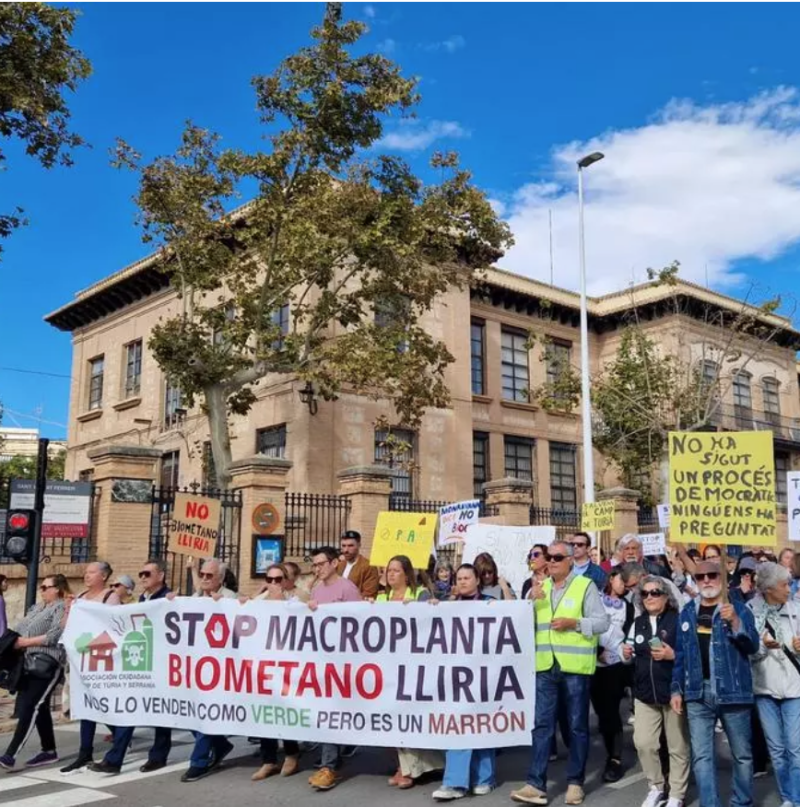
From neighborhood associations in Llíria, Domeño, and Casinos, these are the main reasons for the protests and demonstrations organized against the construction of a plant of this size without local consultation with residents:
Reasons for rejection in Llíria, Domeño, and Casinos:
- Geographical proximity: Residents argue that, although the plant legally belongs to Llíria, it is located barely a kilometer from Domeño and very close to Casinos, transferring the problems (odors and traffic) to these towns.
- Transport footprint: They denounce that the plant will process up to 195,000 tons of waste annually coming from other regions and even provinces. The CO2 generated by the trucks would negate the environmental benefit and the concept of a circular economy.
- Mega-plant vs. Local Model: They argue that true "circularity" should be based on small, local waste management plants, not a centralized "mega-facility" that turns Llíria into the area's "industrial dumping ground" and is solely driven by profit.
- Risk of Animal By-Products (ABP): The treatment of animal by-products (carcasses or viscera) is met with resistance due to the risk of odors and aquifer contamination, which they consider contrary to sustainability.
Legal Action
The mayor of Casinos, Miguel Navarré, has announced that the town council will appeal to the courts to try to halt the final permit, alleging that they were not consulted beforehand.
Origin of the Conflict
The Partido Popular of Llíria points to Manolo Civera (former mayor from the Socialist Party) as the original driving force behind the project presented in 2021, although the controversy has erupted under the current administration due to the increase in the projected volume of waste (up to 195,000 tons).